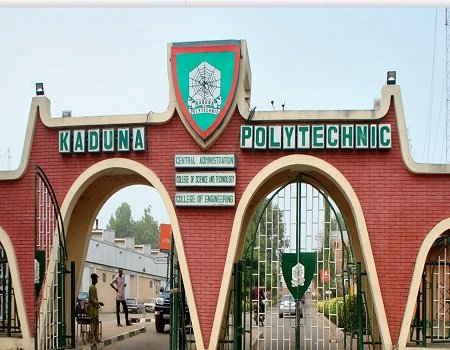
National President, Kaduna Polytechnic Alumni Association, Abba Anas Adamu, has said members of the association have vowed to save the polytechnic in spite of the socio-economic problems facing most tertiary institutions.
He made this assertion at the weekend during the 2021 Bi-Annual General Meeting (AGM) of the association held in Kaduna at the weekend.
Adamu noted that technical education requires huge capital investment which the alumni could help Kadpoly with. “Kaduna Polytechnic is the largest polytechnic South of the Sahara. We are proud graduates of the polytechnic. We cannot, therefore, allow it to sink. We must act to save it, and the time to act is now! “Any institution’s alumni is the reflection of its past, pride of its present and its hope for a better future. And so, institutions and their alumni often collaborate towards common goals. Education and technical education, in particular, require huge capital investment.
“Adequate funding is needed to provide the needs of institutions, like adequate human resources for teaching, learning and research activities; also infrastructure and instructional facilities play significant roles at great costs. Alumni can help greatly in this regard.
“My fellow alumni, let me use this opportunity to remind you that as members, you have the responsibility of supporting your institution, offer your experience and skills to the institution and younger members, give employment opportunities to members, and offer mentorship and scholarships to younger members. “It is in this regard that we were able to identify some prominent old students of Kaduna Polytechnic and we are currently in liaison with some and determining our working relationship with others.
“It is this liaison that led to a national retreat of some stakeholders in Abuja in March this year. The meeting enabled us to identify the problems of Kaduna polytechnic in a more structured way and map out some solutions on the spot.
“A strategic planning committee was formed and has since submitted its report. The plan which contains set goals has charted steps towards their realisation. To ensure that the association gives the plan the paramountcy it deserves, we shall formally present it to members today so that we shall all be on the same page.
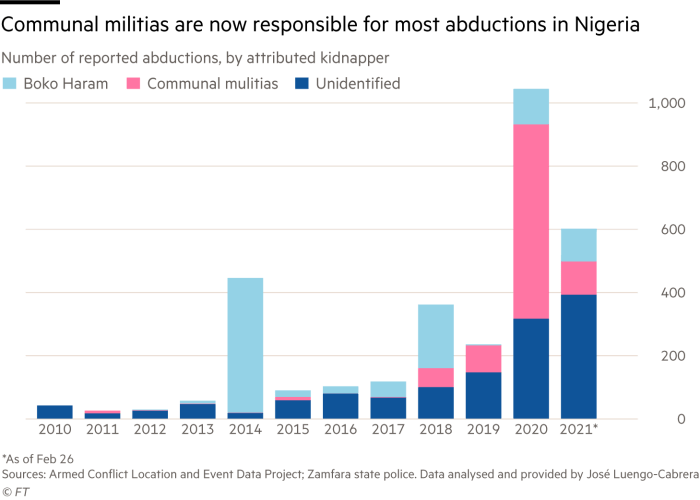
Kidnapping has formed part of the everyday security struggle of the average Nigerian. In farms, highways, places of learning and households, kidnapping incidents have become imminent, affecting anyone and everyone. In 2021, about 1,876 people were kidnapped in 640 attacks within the Nigerian turf, according to the Nextier SPD Violent Conflict Database. This includes expatriates. For profit purposes or as bargaining chips, many people, especially school children in recent times, have become vulnerable to kidnappers who act independently or belong to an elaborate terrorist organisation or criminal network. Daily reports and tracked data from the Nextier SPD Violent Conflict Database reflect the increasing vulnerability of school children in places of learning and the propensity of ransom kidnaps.
At least one million have been demanded for the release of different batches of kidnap victims in 2021. For example, in February 2021, bandits demanded ₦800 million to release the kidnapped Kagara schoolboys. On 4th May 2021, 17 out of 23 kidnapped students of Greenfield university were released by bandits. Five of the students were later killed by the bandits in a bid to press home their demand of ₦100 million. The Nigerian government has either kept mum about the payments or denied it outrightly.
Nigeria’s kidnapping business is flourishing and may be funding other criminal activities. In the northeast, people are kidnapped by terrorists to demand for ransom, coerce membership or forced to partake in terrorist activities. The recurring trend in the bandits’ rampaged northwest and north central zones is for ransom purposes and sometimes outright murder. In southern Nigeria, a case could be made for kidnapping for child trafficking, ritual killings, arbitrary demands, ransom payment and other unknown reasons. Regardless of the different reasons for the spate of kidnapping in Nigeria, it is a cankerworm that is impoverishing many victims, threatening the safety of schools and providing revenue opportunities for multiple non-state armed groups. According to a report, the cost of kidnapping in Nigeria is put at $18 million between 2016 and 2020.
Reactive efforts to secure the release of abducted victims will not only continue but keep the cycle of abduction and evasion running. The Nigerian government’s efforts must be to make areas prone to kidnapping safe by improving security and employing intelligence gathering during hostage situations. If the security situation is improved, it will reduce the risks of abduction and the chances of ransom payment. The burden of Nigerian security agencies is to intensify aggressive measures to end the kidnapping spree currently prevalent in Nigeria.
From news reports, kidnapping gangs operate from hidden locations such as thick forests, abandoned houses and many ungoverned spaces. Nigeria must re-establish its government presence in rural areas and kidnappers’ hideouts. Internal and external border management protocols should be improved to monitor illegal points that aid criminals to evade capture. It is also time to pay more attention to community policing, which will help to bring government presence and security to inaccessible communities in the country. This should then include quasi-security frameworks, especially in rural areas, to complement overwhelmed security measures in those locations.
Technology also provides alternative measures to curb kidnapping. The Nigerian security agencies must work collectively through technology to identify locations where kidnapping victims are being held, track online conversations and apprehend criminals. The use of technology will also aid other securitisation measures of security organisations in Nigeria. The Nigerian government must be proactive rather than reactive in implementing sustainable solutions to end the kidnapping boom and the gloom that trails it.
Nigeria still complaining of lack of funds upon all the borrowing. Where on earth are we going?
The worst highlight of the first quarter of 2021 for me was defaulting on a loan for a couple of days, the consequences were interlocked and it basically interrupted the rhythm of my life. One second I was trying to make sense of a paragraph and the next second my conscience torments me by reminding me of my long overdue debt. Sometimes, I would be in a state of shock and a heavy blanket of lethargy would fall upon me. It is not too different for a country that is beginning to find comfort in taking potentially bad debts. It was when someone responded to Nigeria’s ostentatious care for foreigners such as Chinese citizens with a funny remark about our debt to China that I began to think about the case of a debt trap again.
Before now, there had been numerous comments on the dangers of relying too much on loans from China since our official diplomatic relations with the Chinese, established in 1971, is supposed to be more symbiotic. We have obviously been great trading partners, with Nigeria being the buyer most of the time. The tagline Made in China is hardly alien to any Nigerian and many Nigerian business owners have invested heavily in the Chinese market for over two decades.
In between trading and investing, the Nigerian government has been borrowing. China has been happy to lend too. Many countries borrow at one point in time or the other, and from their fellow countries in the international community. However, the increased borrowing from one particular nation is bound to raise concerns about the balance of the bilateral relationship between the lender and the borrower. Although the Buhari government has had to deny that the country is becoming too reliant on loans from China, Nigerians have become increasingly uneasy with this unidirectional benevolence in a bilateral relationship with China.
Some of the issues raised in some of the public debates about Nigeria’s indebtedness to China now include speculations that the Nigerian government is risking Nigeria’s sovereignty by staking it on a gamble with the country’s ability to repay such debts in due time. The Buhari cabinet insists that the country is not at risk even if it defaults. On August 2020, the minister of transport, Rotimi Amaechi, said that “we must learn to pay our debts and we are paying, and once you are paying, nobody will come and take any of your assets,”. Now China and the Nigerian government can continue to assure us that the borrowings of Buhari will not mar diplomatic ties between Nigeria and China or force a Chinese takeover, but Nigeria is obligated to be in a financial position of constant repaying and therein lies our woes.
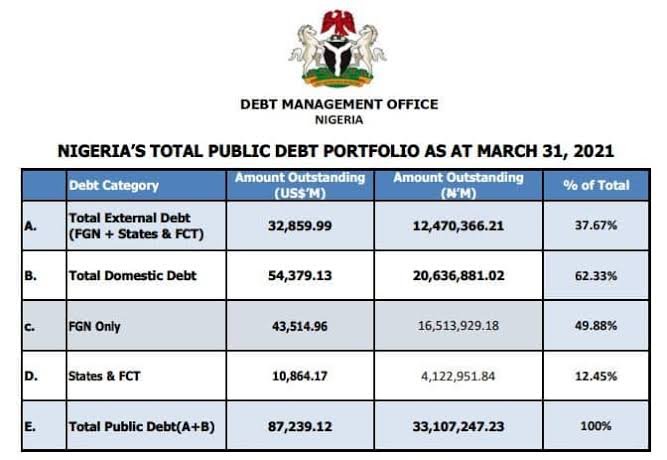
At the end of 2020, according to Quartz Africa and the most recent official data available, Nigeria’s public debt was 32.9 trillion Naira or 86.3 billion dollars. This data was collected from the country’s debt management office.
“This debt comprised: N12.7 trillion ($33.3 billion) in external debt, all of it contracted by the federal government, and N20.2 trillion ($53 billion) in domestic debt, including loans by banks. Of this amount, the federal government owed N16 trillion ($42 billion) while the balance was loaned by the state governments and the federal capital territory.
Of the external debt, 9.7% of N1.2 trillion ($3.3 billion) was owed to the Export-Import Bank of China. This is a state-owned and funded bank that supports China’s foreign trade and investment.
The debt to China formed 80.1% of the bilateral debt, or $4.1 billion. Bilateral debt generally refers to debt loaned by one state to another state. Other countries that have lent to Nigeria are France, Japan, India, and Germany. Multilateral debt, or debt owed to international financial institutions such as the African Development Bank, the World Bank and the International Monetary Fund, stood at $17.9 billion.”
We have been dancing with fiscal crises, reporting low national savings, extremely low income with a devalued currency, and spending cuts here and there. The next time a Lai Mohammed or Chris Ngige complains about Nigeria’s inability to respond to certain problems because of lack of funds, it is safe to say that they have condemned, indeed complained, about the consequences of extensive borrowing.
The House of Representatives has passed a bill seeking to end the dichotomy between university degrees and the Higher National Diplomas awarded by polytechnics.
The bill proposes to make it a crime for any person or organisation, both in the public and private sectors, to discriminate against HND certificate holders.
It passed the third reading at the plenary on Tuesday.
The House had on Thursday considered and adopted the report by the Committee on Tertiary Education and TETFund on the Prohibition of Discrimination between First Degrees and Higher National Diplomas Bill, 2021, as a Committee of the Whole.
The legislation is titled, ‘A Bill for an Act to Abolish and Prohibit Dichotomy and Discrimination between First Degree and Higher National Diploma in the Same Profession/Field for the Purpose of Employment; and for Related Matters.’
On equity of First Degree and HND in Nigeria, the bill says, “Notwithstanding any provision in any legislation, circular, regulation or policy guideline, First Degree and Higher National Diploma shall be deemed construed and treated as equivalent qualification for the purpose of employment and career progression at workplace in the public and private sectors of the Nigerian economy.
“Any provision in laws, enactments, instruments, circulars, scheme of service, directives, or policies by whatever name called, which is inconsistent with the provisions of this bill, shall to the extent of the inconsistency be null and void, and of no effect.
“Holders of the First Degree and the Higher National Diploma (HND) shall be given equal treatment and opportunity in career placements, career progression, admission to further studies and privileges whatsoever in consideration of status as graduates of Nigeria tertiary institutions of higher learning.”
On prohibition of discrimination between a degree and HND, the bill proposes that “all forms of discriminations and or dichotomy between First Degree and Higher National Diplomas for the purpose of employment, transfer of service, conversion of cadre, career progression, promotion, and other related issues in the public and private sectors of the Nigerian economy is hereby abolished.
“No person, authority, entity (body or corporate) in whatsoever name call shall discriminate and or undertake any action in any form whatsoever which is misconstrued as and or intended to give any preferential treatment in favour of and/or against holders of the First Degree or the Higher National Diploma.
“Any person or entity in the public or private sectors of the Nigerian economy who contravenes the provisions of this bill, commits an offence under this bill, and shall be liable upon conviction to a term of two years’ imprisonment or a fine of N1,000,000 or both.
“Any person or entity in the public or private sectors of the Nigerian economy who design, prescribe and or specify any guidelines, terms or conditions of employment, career progression, and or any other instrument by whatever name called in violation of the provisions of this bill shall be guilty of an offence under this bill and liable upon conviction to a term of 1-year imprisonment or a fine of N500,000 (five hundred thousand naira) or both.”
On offences, the bill prescribes that any person who induces or encourages any other person for the violation of any of the provisions of this bill shall be liable upon conviction to a fine of N500,000, imprisonment for a term not exceeding one year or to both.
On the enforcement of the proposed law, the bill prescribes that where an officer of any entity in the public or private sector fails to comply with the provisions of its provisions, the person shall be guilty of an offence and liable upon conviction to an imprisonment term of six months or a fine of N500,000 or both.
“Where in any proceedings against any person for an offence under this bill, it is established that any action constituting an offence under this bill has been committed by an officer, it shall be presumed that the action was done with the motive or intent of committing an offence under this bill as the case may be, until the contrary is proved,” the legislation partly read.
Meanwhile, the House passed amendments to the National Business and Technical Examinations Board Act for second reading on Tuesday.
Chairman of the House Committee on Basic Education, Prof Julius Ihonvbere, sponsored the amendment bill.
The legislation is titled, ‘A Bill for an Act to Amend the National Business and Technical Examinations Board Act, Cap. N12, Laws of the Federation of Nigeria, 2004 to Improve the Scope of the Board, to Undertake Contemporary Business and Technical Examinations in Line with the National Policy on Education, Provide the General Purpose of the Results, Certificate and Awards Issued by the Board; and for Related Matters.’
A Federal High Court in Abuja has sentenced Abdulrasheed Maina, the former chairman of the now-defunct Pension Reformed Task Team to eight years imprisonment.


 Maina was convicted after he was found guilty of money laundering,In a judgement delivered on Monday by Justice Okon Abang, the court held that the prosecutor, the Economic and Financial Crimes Commission (EFCC) has produced essential evidence through witnesses to prove beyond reasonable doubt that Maina is guilty of money laundering in the sum of N171,099,000.

 Maina was also found guilty of concealing his true identity as a signatory to accounts opened in two banks – UBA and Fidelity bank – by using the identity of his family members without their knowledge, These accounts had cash deposits of N300million, N500million, and N1.5billion.

The court held that Maina stole monies meant for pensioners as he could not prove where he got them from.


Court Sentences Maina To Eight Years Imprisonment
Emmanuella Eke
Updated November 8, 2021
22

A Federal High Court in Abuja has sentenced Abdulrasheed Maina, the former chairman of the now-defunct Pension Reformed Task Team to eight years imprisonment.

Maina was convicted after he was found guilty of money laundering.

In a judgement delivered on Monday by Justice Okon Abang, the court held that the prosecutor, the Economic and Financial Crimes Commission (EFCC) has produced essential evidence through witnesses to prove beyond reasonable doubt that Maina is guilty of money laundering in the sum of N171,099,000.

Maina was also found guilty of concealing his true identity as a signatory to accounts opened in two banks – UBA and Fidelity bank – by using the identity of his family members without their knowledge.

These accounts had cash deposits of N300million, N500million, and N1.5billion

The court held that Maina stole monies meant for pensioners as he could not prove where he got them from.

The court also found Maina guilty for the purchase of a property in Abuja paid in cash in the sum of $1.4million, which is above the statutory threshold of N5million and without passing through a financial institution, describing it as a criminal offense.
Shekau died in May 2021 after waging a deadly war against the Nigerian state that led to the death of over 100,000 thousand people, displacement of over three million people and destruction of towns, villages, schools, hospitals and other social amenities valued at over $9bn, according to data released by the state, national and international organisations. Falmata Abubakar, the mother of the late vicious Boko Haram leader, Abubakar Shekau, said she regretted giving birth to him. Except his village, Shekau’s reign of terror did not spare his kinsmen in Borno and Yobe states; even as pain and agony were inflicted on people in all the states in the North East, North West, North Central and other parts of Nigeria.
It was learnt that since the time he left his ancestral village when he was young, Shekau visited only once during which he said he was there to revert the people to Islam even though they were all born and brought up as Muslims for decades. The village, located 50 kilometres from Babban Gida, Tarmuwa LGA of Yobe State, is populated by Kanuri, Fulani and Manga who embraced modernity, including sending their children to formal schools which Shekau detested.
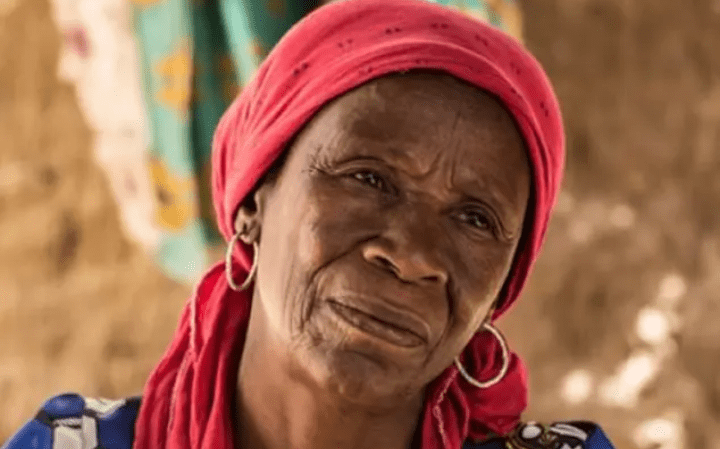
“I don’t know if he (Shekau) had any offspring,” his mother said.
Falmata said: “I gave birth to him and that is the only and last thing between us. Whether he is alive or not; we have parted ways. I never knew whether he had any offspring. He inflicted severe pain on me. God Almighty will judge between us in the hereafter.”
The district head of Shekau, Malam Lawan Gana, described the late Boko Haram leader as ‘stubborn”; while his uncle, Zannah Sule, described him as a “disaster to us.”
Born in the 70s, Shekau took over from the founder of the group, Mohammed Yusuf in 2009 and was denounced by Islamic State West Africa Province (ISWAP). Before his dethronement, Shekau had sworn allegiance to IS in March 2015.
His dislodgement in 2016 heralded the rise of the relatively young Abu Mus’ab Al-Barnawi (son of Yusuf) as ISWAP leader and at the same time the split of the terrorist group into two factions until when ISWAP fighters engaged Shekau in a fierce battle that led him to kill himself at one of his enclaves.
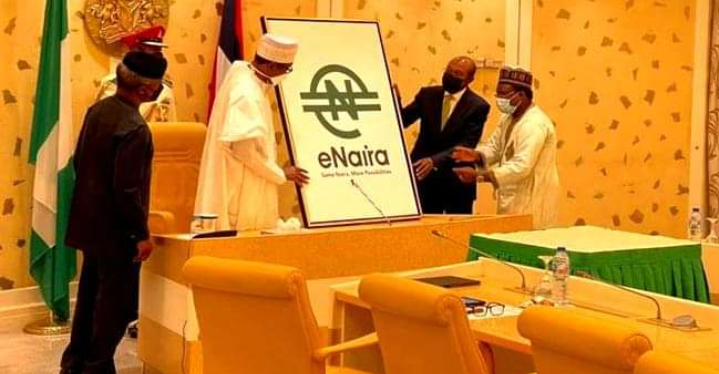
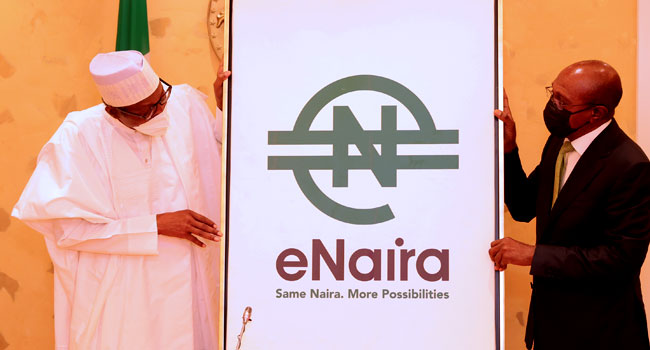
The event was held on Monday at the State House in Abuja, with the Vice President, Yemi Osinbajo; governor of the Central Bank of Nigeria (CBN), Godwin Emefiele, and other dignitaries in attendance.
President Buhari said the adoption of new CBN digital currency is estimated to increase Nigeria’s GDP by $29 billion over the next 10 years.
“We have become the first country in Africa and one of the first in the world to introduce a digital currency to our citizens,” Buhari said at the event. Other countries like China, Bahamas, and Cambodia have also launched digital currencies. Additionally, the new payment system which has taken four years to crystallise, will drive financial inclusion, serve as a backbone for electronic payment in Nigeria and also enable the movement of more people from the informal to the formal sector, hence scaling up the tax base of the country.
We understand that some candidates have login issues where the site reloads without actually logging them in.
If you encounter such, use a Different Web Browser, Device or Switch your Data Network. Note that this is a client-side error and we cannot help more than tell you the above mentioned. Of it persists, use a computer or visit a cafe.
2. Enlisting Issue
Only Pre-Selected candidates will be able to enlist for the Document Verification and Aptitude Test. Ensure you are logged in to your dashboard and click the Green Pre-Selected Flip Box.
Once flipped, click on ENLIST. Ensure you read and understand the enlisting terms. It explains the process and category of questions to prepare for.
3. Uploading Documents
If you are not conversant with uploading documents online, please visit a Cyber Cafe or ask a friend for help.
You can upload your documents in JPEG, PNG or PDF formats. You can also simply take a photo of your documents and upload.
Ensure that the size is less than 1mb per file. The smaller, the better.
Your School/Jamb Admission Letter can serve as your ID Card if you are yet to be issued an ID Card.
If you are yet to sit for an examination or do not have results yet, leave it blank and provide an explanation.
Note that once the form is submitted, you cannot change any information unless specifically asked to.
If the form is submitted without documents, please send the documents to documents@collegerelieffund.com through your email registered on the portal.
4. Rolling Submit Button.
In the event that the submit button keeps rolling when uploading your documents, please try a different browser, device or network. Or visit a cafe.
5. Still Seeing Test Days After Selection.
If you still see the list of test dates, simply log out and log back in to confirm.
If it still persists, select a different date without uploading your documents as your documents would have already been submitted.
6. Answers to Practice Test
The practice test is prepared to simulate the real test. However, you are allowed to Google answers to confirm them.
The test is provided so to help you confirm that your device is compatible with the live testing service.
The live test may or may not have the exact format of questions.
Don’t forget to follow up on this page because it will be updated time to time for a new update.
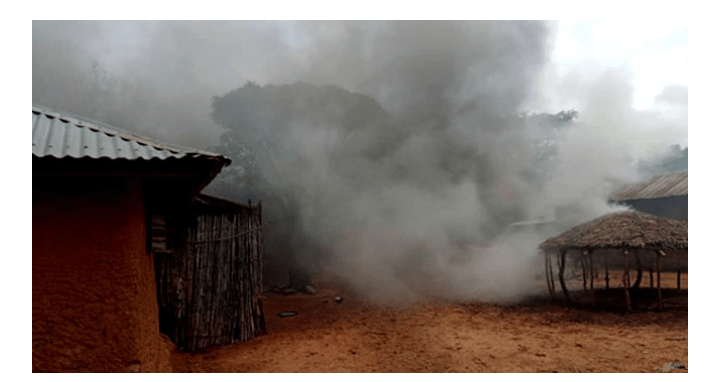
At least not less than ten bandits killed after a gun battle with a joint team of security forces in Giwa Local Government Area of Kaduna State.
The military personnel according to a statement signed on Monday by the Kaduna State Commissioner for Internal Security and Home Affairs, Samuel Aruwan encountered the heavily armed bandits in Kwanan Bataru, in the suburbs of Fatika and engaged them in a gun battle.
One of the camps of the bandits was burnt down, while some of the bandits escaped with gunshot injuries.
Every year on the 11th of October we celebrate the International day of the girl child, a day set aside to support more opportunities for girls and increase awareness of gender inequality faced by girls worldwide. But as we celebrate the girl child we should also reflect and ask ourselves questions.
To what extent have we empowered the girl child in the country?. What we have so far done is making the girl child and women assertive and knows that they have rights to fight for, but still they cannot access the rights they are entitled to.
When faced with life challenges men tend to use work as an excuse and most end up in bars resulting to them arriving home late and drunk. This takes them deeper into drugs and substance abuse which has become a national problem threatening to cripple the nation.
Women though empowered bear the heavy burden of caring for the family single handedly. However all is not lost and we can start a new balanced empowerment legacy. As an individual, you can choose to become a role model and empower the future generation.
As much as we try to empower the girl child let us not forget that it is also important to not neglect the boy child in this empowerment.
This is a country of equalization and we must empower both the boy and the girl child at equal rates. The nation will be built by the strength of both the boy and the girl child. Let us not emphasize more on one side and leave the other in a lower rate.
Therefore its upon all of us to make sure that when we get a chance to empower a child let us do it on equal basis noting that the mentorship you give to the this young ones will be effective to the future ,lets empower both the boy and girl child at an equal ratio.
Recent statistics by education scholars regionally, show that women are crowding up men in popular scholarly classes with the exchange of sex to earn grades or marks from the male lecturers. This has also reflected in the job recruitment and employment opportunities available.
Boys child suffer
Gender equity notions are erroneous and deceptive. If we de-construct this “truth” from a philosophical point of view, we find that more boys end up in crime than girls; there are more boys in the streets than girls; more boys end up in prison than girls; and research shows that more men die faster than women.
Once a boy child is branded and labelled by society, he keeps the tag into adulthood. Society neither forgives nor forgets the transgressions of a boy child easily.
The abuse of a boy child — whether physical, verbal, psychological or sexual — is always swept under the carpet. But if a girl child is concerned, all hell breaks loose.
My line of work has exposed me to heart-rending cases of abuse of the boy child. In all the cases, the victims become bundles of anger, lies and delinquency.
Why should the boy child of today suffer just because historically the girl child was marginalized? Aren’t we also creating disparities that would need future rectification in the process?
Both boys and girls need to be educated and mentored. We will be going wrong as a region if we give much attention to the girl child and forget that tomorrow will come when we will need the boys to become men.
There is need for more men to come out as mentors for the boy child, to guide and teach them what is expected of them as they grow up into men. After all we need each other for a healthy nation.
Justice Okon Abang of the Federal High Court sitting in Abuja, today Thursday, October 7, 2021 convicted and sentenced the son of former Chairman of the defunct Pension Reform Task Team, PRTT, Abdulrasheed Maina, Faisal, to 14 years imprisonment. The Court found Faisal guilty on a three-count charge of money laundering brought against him by…
2022 BUDGET SPEECH Budget of Economic Growth and Sustainability Delivered By: His Excellency, President Muhammadu Buhari President, Federal Republic of Nigeria At the Joint Session of the National Assembly, Abuja Thursday, October 7, 2021 PROTOCOLS It is my great pleasure to be here once again to present the 2022 Federal Budget Proposals to this distinguished…
Justice Okon Abang of the Federal High Court sitting in Abuja, today Thursday, October 7, 2021 convicted and sentenced the son of former Chairman of the defunct Pension Reform Task Team, PRTT, Abdulrasheed Maina, Faisal, to 14 years imprisonment. The Court found Faisal guilty on a three-count charge of money laundering brought against him by…
Senator Shehu Sani stated that “Kidnapping has become a lucrative business in the North West part of Nigeria whereby they have become an authority onto themselves. In our own state Kaduna, hardly a day goes by without reported cases of kidnapping. In fact, the ones that are reported are when the numbers are much not […]
Poly Alumni cries against selling of institution’s staff quartersPublished on September 17, 2021By Amos TaunaThe National Secretary, Kaduna Polytechnic Alumni Association, Aminu Haruna Maipompo, has appealed to the federal government to shelve the plan of selling some of the staff quarters of the institution.The National Secretary of the Association, who is also the National Organizing […]
Poly Alumni cries against selling of institution’s staff quartersPublished on September 17, 2021By Amos Tauna The National Secretary, Kaduna Polytechnic Alumni Association, Aminu Haruna Maipompo, has appealed to the federal government to shelve the plan of selling some of the staff quarters of the institution. The National Secretary of the Association, who is also the National Organizing Secretary of the Northern Youth Council of Nigeria, observed that selling the quarters would affect the reputation of the school. “Kaduna Polytechnic’s name and reputation are not just in the number of students and staff it has, but also in the number of assets particularly staff quarters spread across strategic locations it has in Kaduna state.” He said. The statement explained that the assets are among what makes Kaduna Polytechnic stand tall among other tertiary institutions across the entire country. He cautioned, “Kaduna Polytechnic is expanding in staff strength every day, so there is a need to build more staff quarters for the institution, not mortgaging the few ones it has.” He said it was disheartening to see the few remaining legacies of the late founding father of Kaduna Polytechnic, the Sardauna of Sokoto traded off. “I wish to call on the Northern Governors Forum, Arewa Consultative Forum, Northern Elders Forum and all well-meaning sons and daughters of the North to please intervene in the said plan,” he pleaded.





 Niceone